
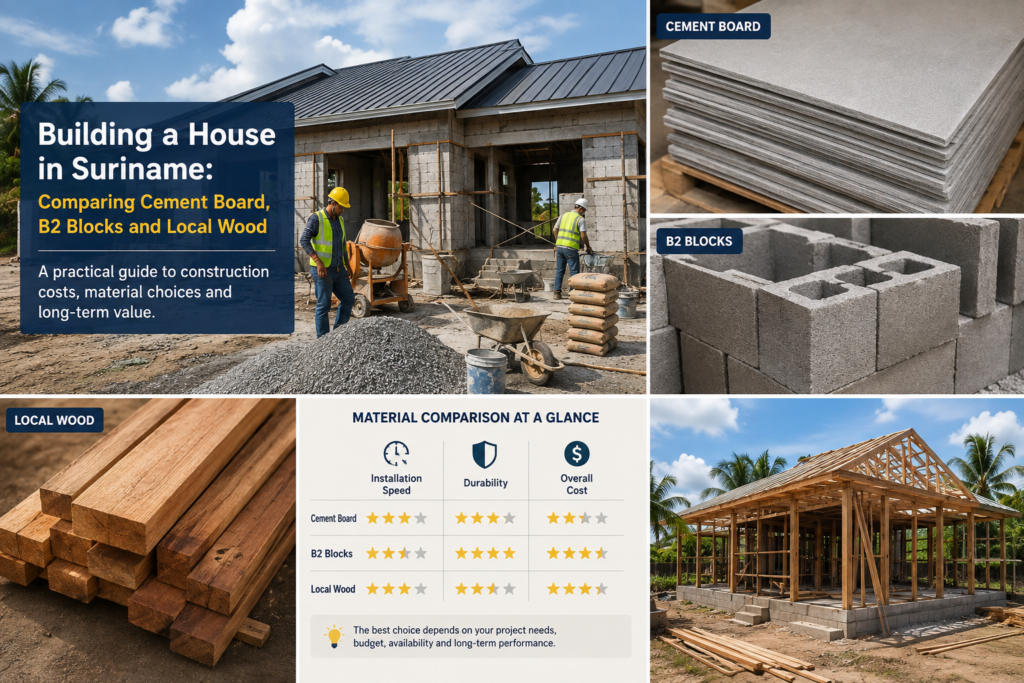
Building a house in Suriname is not simply a matter of choosing a design and calculating the cost of cement and concrete. Material selection, availability, labour, transportation, construction methods, and long-term performance all have a direct impact on the final cost of a project.
One of the decisions that can make a noticeable difference is the choice of material for non-structural walls. In Suriname, builders and homeowners may consider imported materials such as cement board alongside locally produced B2 blocks or local timber.
Each option has its own advantages and limitations. The cheapest material at the time of purchase is not always the cheapest solution over the lifetime of a building.
At Cle Birdland, our focus is on helping construction teams make these decisions based on quality, compliance, durability, and total project cost rather than price alone.
Why Material Choice Matters in Suriname
Construction in Suriname comes with its own practical challenges.
A significant part of the construction cost can be influenced by the availability of materials, import requirements, transportation, storage, and local labour. Imported products can also be affected by exchange rates, shipping costs, customs, and delays.
This means that two materials with similar purchase prices may have very different installed costs.
When selecting a wall material, it is therefore important to consider:
- Purchase price
- Transportation and handling
- Installation time
- Labour requirements
- Availability in Suriname
- Resistance to moisture and weather
- Maintenance requirements
- Expected service life
- Fire and safety performance
- Compatibility with the building design
A proper comparison should always look beyond the initial invoice.
Option 1: Cement Board for Non-Structural Walls
Cement board is commonly used for partition walls and other non-load-bearing applications. It is generally valued for its relatively fast installation and versatility.
Because cement board is an imported product in many markets, however, its cost in Suriname can be influenced by transportation and import-related expenses.
Advantages of Cement Board
One of the biggest advantages is speed.
Cement-board systems can often be installed faster than traditional masonry, especially when the supporting frame has already been prepared. This can reduce construction time and, depending on the project, reduce labour costs.
Other advantages may include:
- Fast installation
- Relatively lightweight construction
- Easy integration with electrical and plumbing services
- A clean finish when properly installed
- Flexibility in interior layouts
- Useful for renovation and partitioning work
However, performance depends heavily on the complete wall system. The board itself should not be considered in isolation.
The frame, fasteners, joints, insulation, moisture protection, and finishing materials all contribute to the final performance.
The Cost Consideration
Imported cement board can become more expensive when shipping, import charges, storage, and delivery are included.
For this reason, the correct question is not simply:
“How much does one sheet cost?”
The better question is:
“What is the total installed cost per square metre?”
That figure should include the board, framing, fasteners, labour, transport, finishing, and any additional protection required.
Option 2: Local B2 Blocks
Locally produced B2 blocks can provide a very different approach.
The use of local masonry materials can reduce dependence on imported products and may offer advantages in terms of availability, transportation, and familiarity among local contractors.
For projects where masonry construction is already part of the construction process, B2 blocks may offer a practical and economical solution for non-structural walls.
Advantages of B2 Blocks
The main benefit of using locally available blocks is often practicality.
Local production means the material may be easier to source, and contractors are generally familiar with traditional masonry construction.
Potential advantages include:
- Local availability
- Reduced dependence on imported materials
- Familiar installation methods
- Good durability when properly manufactured and installed
- Solid and robust wall construction
- Potentially lower transportation costs
But quality is critical.
Not every block should automatically be treated as equivalent. Dimensions, density, strength, curing, water absorption, and manufacturing quality can all influence the performance of a masonry wall.
A low-cost block that does not meet the required quality standard may create additional costs later through cracking, moisture problems, repairs, or rework.
Option 3: Local Wood
Wood remains another possible option, particularly for certain residential applications and projects where speed, flexibility, and local materials are priorities.
Local timber can provide a different aesthetic and construction approach, but its performance depends greatly on species, moisture content, treatment, detailing, and protection from environmental conditions.
Advantages of Wood
Properly selected and treated timber can offer several benefits:
- Lightweight construction
- Fast installation
- Flexibility in design
- Potentially lower structural load
- Good suitability for certain residential applications
- Strong local material potential
At the same time, timber must be carefully managed.
Moisture, insects, decay, ventilation, and maintenance all need to be considered during design and construction. Using untreated or unsuitable timber simply because it is cheaper can create significant problems later.
Imported vs. Local Materials: Which Is More Economical?
There is no single answer.
The right choice depends on the building, location, availability of materials, labour costs, construction schedule, and quality requirements.
A simple comparison may look like this:
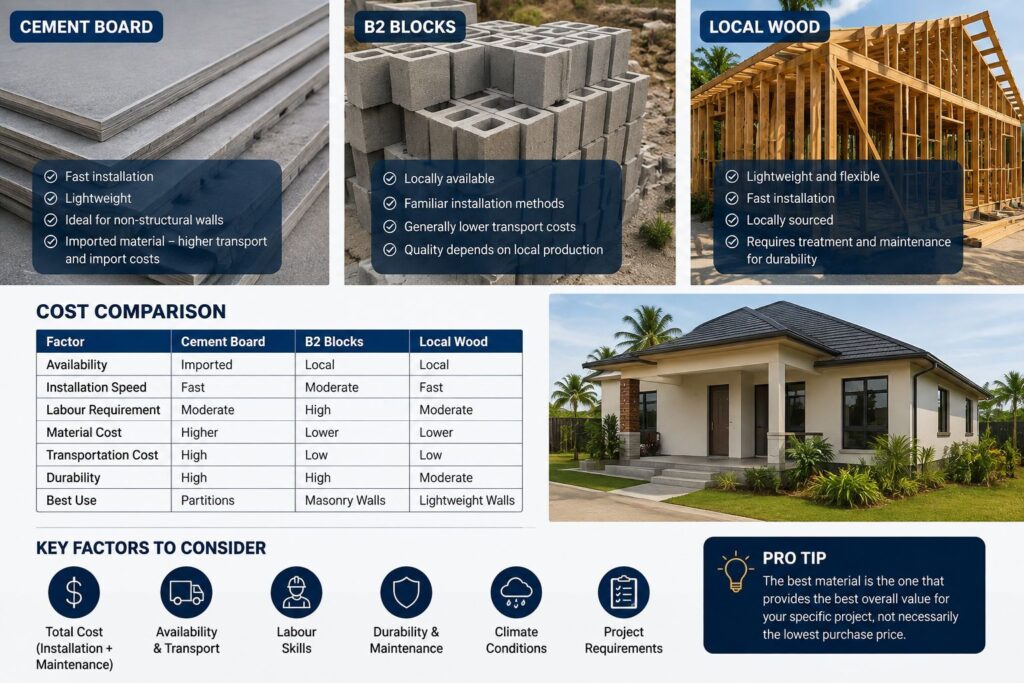
| Factor | Cement Board | B2 Blocks | Local Wood |
| Availability | Dependent on imports | Locally available | Locally available depending on supply |
| Installation speed | Generally fast | Moderate | Generally fast |
| Labour familiarity | Depends on contractor | High | Depends on contractor |
| Transportation | Can be higher | Often lower | Often lower |
| Weight | Lightweight | Heavier | Lightweight |
| Moisture considerations | Requires suitable detailing | Depends on construction and finish | Requires protection and treatment |
| Maintenance | Depends on system | Generally low when properly built | Can require more maintenance |
| Best suited for | Fast partitions and selected applications | Robust masonry walls | Lightweight and flexible construction |
This table is only a starting point. A real project should always be evaluated using its actual quantities, local prices, labour rates, and technical requirements.
The Importance of Total Cost of Ownership
One of the most common mistakes in construction is choosing a material based only on its purchase price.
For example, a material may appear inexpensive but require additional framing, specialist labour, imported accessories, more finishing, or higher maintenance.
Another material may have a higher initial purchase price but reduce installation time and future maintenance.
This is why professional cost evaluation should consider the total cost of ownership.
A useful comparison should include:
Material + Transport + Labour + Installation + Finishing + Maintenance + Expected Service Life
This approach gives a much clearer picture of the actual value of each construction system.
What About Suriname’s Climate?
The local climate should also play an important role in material selection.
Suriname’s warm and humid conditions mean that moisture management should be considered carefully during construction.
Walls should be designed and installed with appropriate attention to:
- Water penetration
- Condensation
- Ventilation
- Drainage
- Surface protection
- Material compatibility
- Long-term maintenance
The best material is not necessarily the one that looks cheapest on paper. It is the one that performs reliably under the actual conditions of the project.
Local Materials Can Be Part of a Smarter Strategy
Using local materials does not automatically mean compromising on quality.
In fact, increasing the use of reliable local construction materials can provide several advantages. It may reduce dependence on imports, shorten supply chains, improve availability, and support local production.
However, local materials still need to meet the technical requirements of the project.
The objective should not be:
“Use local materials at any cost.”
Nor should it be:
“Imported materials are always better.”
The better approach is to evaluate each material based on performance, quality, availability, cost, and suitability for the specific application.
Final Thoughts

The cost of building a house in Suriname depends on much more than the price of the main building materials.
When comparing cement board, B2 blocks, and local wood for non-structural walls, the most effective decision comes from looking at the complete construction system rather than a single material price.
For some projects, imported cement board may offer speed and flexibility. For others, locally produced B2 blocks may provide a more practical and economical solution. Local timber may also be suitable where lightweight construction and local availability are important considerations.
The key is to make the decision based on actual project requirements and reliable cost information.
At Cle Birdland, we believe that good construction decisions begin with quality, technical knowledge, and proper planning. A well-designed material strategy can help reduce unnecessary costs, prevent rework, and improve the long-term performance of a building.
Quality begins with the right decision — before construction even starts.
Need Help Evaluating Construction Materials?
If you are planning a residential or commercial construction project in Suriname and need independent advice on material selection, quality control, or construction costs, Cle Birdland can help you assess the technical and practical options before work begins.
Cle Birdland – Construction Quality You Can Trust